


The sixth and final part of this short series on managing change and the challenge of shifting established routines, mindsets and procedures.
Let’s end where we began... with a question. Over the last five articles, have I actually changed your mind about anything? Or, if you’ll forgive me for borrowing my own opening from Part One, when did someone last change theirs because of something you did?
I ask because this final instalment isn’t going to hand you a shiny new theory. Instead, I want to do two things: gather up the threads of the previous five articles into something you can actually hold, and then point you towards the structured, well-tested approaches that can carry you the rest of the way. Think of it as the map tucked into the back of the guidebook.
What we’ve learned so far
We started, in Part One, with an uncomfortable truth: people rarely change their minds because you’ve out-argued them. Change is an intrusion, and more often than not, what looks like agreement is really just a quiet change in behaviour. Winning someone over means engaging the heart, not only the head.
Part Two gave that instinct a backbone. Borrowing from Dan Ariely, from Dr Rapaille’s “reptilian brain”, and from Jung’s two tribes of thinking and feeling, we saw that the truth of a situation never lives in a single frame. If you want both tribes on side, you have to frame change twice; once in facts, once in feelings.
Part Three turned to another of Jung’s distinctions: the Sensors, who trust concrete facts, stability and proof, and the Intuitives, who thrive on possibility, patterns and vision. The answer there was a “dual-speed” approach: slower and well-evidenced for the one, visionary and exploratory for the other.
Part Four was a plea on behalf of the quiet ones. In a world that rewards the loudest voice in the room, introverts often get steamrollered and their considered, often wiser, input is lost. Written feedback, quiet reflection time and one-to-one check-ins aren’t niceties; they’re how you hear the half of the room that always thinks before it speaks.
And Part Five pulled the camera all the way back. Drawing on Peter Senge’s work, we stopped treating change as a series of isolated events and started seeing the school as a living system; people, policies, culture and routines, all interconnected, where a tug on one thread is felt across the whole cloth.
The thread that runs through all of it
Lay those five articles side by side and a single thread runs through every one. Not one of them was really about procedure. They were about people; the emotional, contradictory, differently-wired human beings on whom every plan eventually lands.
And here is what’s worth saying out loud as we close. The change-management world is full of excellent, structured frameworks and I do encourage you to use them. But almost all of them describe the steps of change. Very few teach you much about the people the steps are performed upon. That gap, between the tidy diagram on the slide and the messy staffroom it has to survive, is exactly where so many change initiatives quietly die. This whole series has been an attempt to fill it.
A toolkit worth keeping
So where should you look for the structure? Here are the approaches I’d keep in your back pocket, with a note on who each one tends to suit:
- Lewin’s Unfreeze–Change–Refreeze. The simplest mental model there is, and a fine place to start; we met it back in Part Three. Just remember your Intuitives may never much want to “refreeze”.
- Kotter’s 8 Steps. Urgency-led and built for big organisational shifts. It will energise your Intuitives; pair it with early, visible wins to reassure the Sensors.
- The ADKAR model (Prosci). Refreshingly practical and individual-level: Awareness, Desire, Knowledge, Ability, Reinforcement. A checklist your Sensors will love.
- Bridges’ Transition Model. The one that treats endings, the “neutral zone” and new beginnings as emotional transitions rather than mere logistics. A natural companion to Parts One and Two.
- Senge’s systems view. Less a step-by-step recipe than a way of seeing; our anchor from Part Five, it’s for anyone leading change in something as interconnected as a school.
The one I reach for most
If you make me choose a favourite, it’s the one that comes, from Stanford: Chip and Dan Heath’s Switch. Its genius is a single, sticky picture. Imagine a Rider perched on top of an Elephant, on a Path. The Rider is our rational mind — all logic and planning. The Elephant is our emotional side — vastly stronger, and the one that actually decides whether we move. And the Path is the environment around them both.
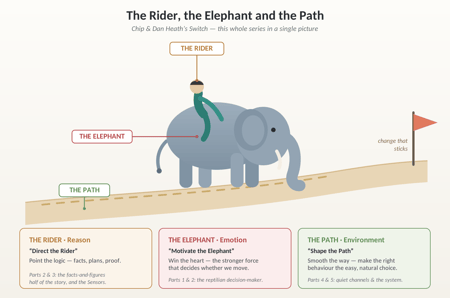
The reason I come back to it frequently is that it is, more or less, this entire series compressed into three words:
- Our Elephant is Parts One and Two - the reptilian decision-maker, feelings running on ahead of the facts.
- Our Rider is the facts-and-figures half of Part Two, and the Sensors of Part Three.
- And the Path is Parts Four and Five together — because shaping the environment (a quiet channel for the introvert, a well-understood system for everyone) is precisely how you make the right behaviour the easy one.
Direct the Rider, motivate the Elephant, shape the Path. Point the logic, win the heart, smooth the way. If you remember nothing else from these six articles, that will serve you handsomely.
And finally — you don’t have to do this alone
There’s a reason this series has returned, again and again, to the same gentle insistence: no one should have to face change by themselves. That was true of the introvert we didn’t want to overlook, and of the overwhelmed leader staring at a system whose edges they couldn’t quite make out. It’s every bit as true of the person reading this.
Choosing the right framework (and far harder, seeing and reading the Elephant in a colleague, a department or a whole staffroom) is not a solo task. It never was. It’s precisely the sort of thing a community of people who have done it before exists to help with.
Real change will never stick because we command it to. It will have ‘stuck’ because we understood the people, saw the system, and had the good sense not to walk the path alone. When we lead in that way, we don’t just manage change, we build schools that adapt, grow and thrive.
Thank you for reading, over all six parts. Now; go and change a mind. One hint? You might need to change your own, first 😊.
Side Box
With reference to the photo at the top of this article, there’s a line often attributed to Antoine de Saint-Exupéry: “If you want to build a ship, don’t drum up the crew to gather wood… teach them to long for the endless immensity of the sea.” It’s a fitting note on which to end a series about change. Every framework in this article is a way of gathering the wood... necessary, structured and sensible. But the wood is (and was) never the hard part. The longing (the Elephant, the heart and the why) is what actually builds the ship. So direct the Rider all you like; but remember that in the end, it’s the Elephant that longs for the sea.
Main References
Heath, C., & Heath, D. (2010). Switch: How to change things when change is hard. Broadway Books.
Bridges, W., & Bridges, S. (2017). Managing transitions: Making the most of change (4th ed.). Da Capo Lifelong Books. (Originally published 1991.)
Hiatt, J. M. (2006). ADKAR: A model for change in business, government and our community. Prosci Learning Center Publications.
Kotter, J. P. (2012). Leading change. Harvard Business Review Press. (Originally published 1996.)
Lewin, K. (1947). Frontiers in group dynamics. Human Relations, 1(1), 5–41.
Senge, P. M. (2006). The fifth discipline: The art and practice of the learning organization (Rev. ed.). Doubleday.
(6 of 6 part series - Change Management)
Click here for the 5th part of the series: Change That Lasts - Why Systems Thinking Matters in School Leadership